BLUETTI Elite 30 V2 vs EcoFlow RIVER 3 Plus Wireless Combo
These 600W power stations are nearly twins on paper. The Costco EcoFlow bundle is the better buy for most people, but the lighter BLUETTI is easier to travel with.
Quick Take
- Buy the Costco EcoFlow combo for its two detachable phone batteries and room to expand.
- Buy the BLUETTI if lower weight and two high-powered USB-C ports matter more.
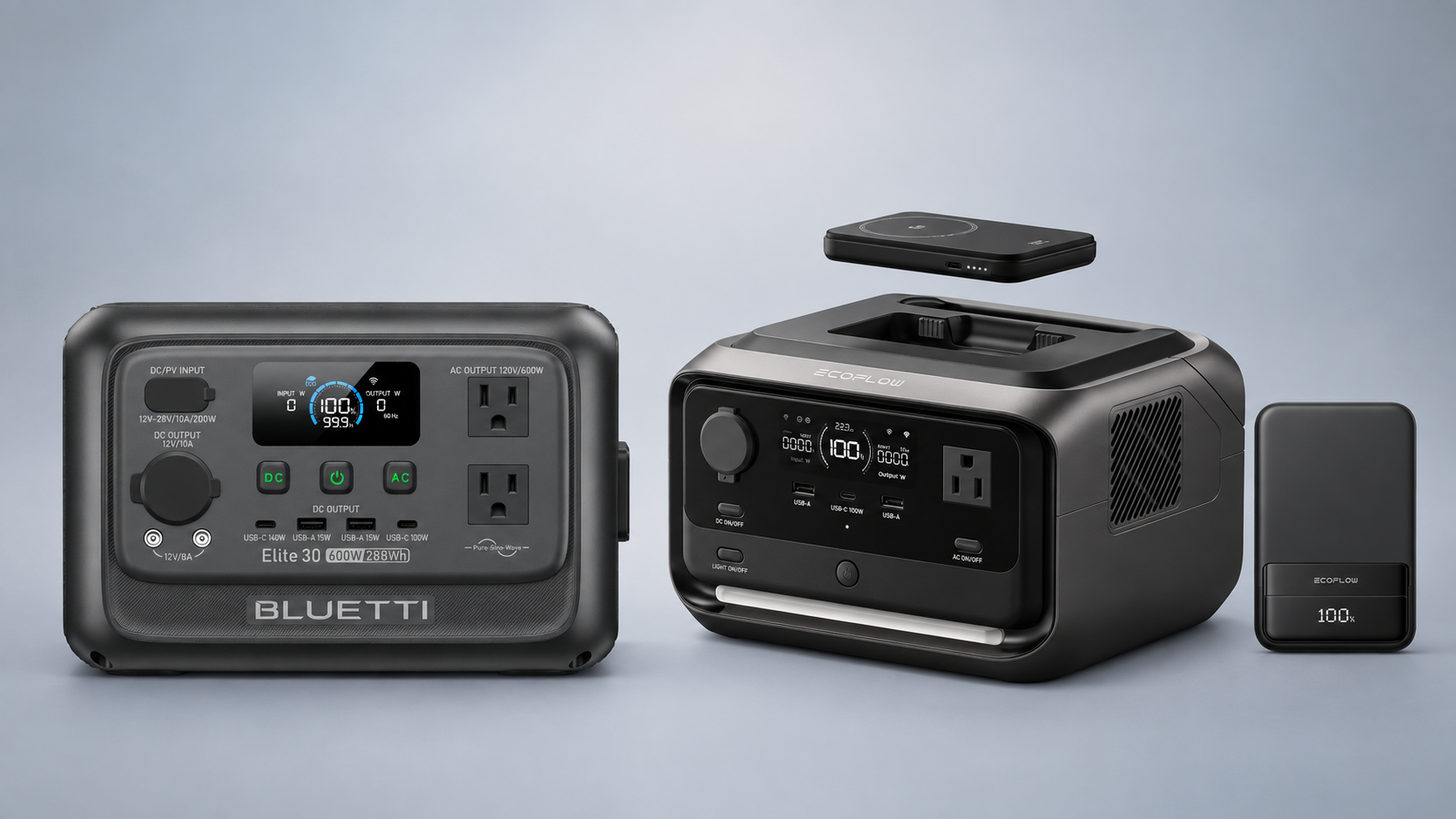
On paper, these two power stations are nearly identical. The BLUETTI has a 288Wh battery, the EcoFlow 286Wh. Both put out 600W, work as a fast-switching UPS, and come with a five-year warranty.
But I would buy the Costco EcoFlow combo. Not for a dramatically better power station, but because Costco includes two detachable magnetic phone batteries, and the EcoFlow can take an extra battery later. This offers more versatility.
The BLUETTI still has a strong appeal. It is lighter, and its two USB-C ports are better suited to laptops. If I were carrying one between home, the car, and a campsite all the time, that might be enough to change my answer.
BLUETTI Elite 30 V2 vs EcoFlow RIVER 3 Plus Wireless Specs
On the basics, there's little difference. Both use LiFePO4 cells rated for over 3,000 cycles to 80 percent capacity. Both switch to battery in 10 milliseconds or less during an outage and stay under 30dB under light loads.
Marketing shows bigger numbers. EcoFlow says X-Boost can handle certain appliances up to 1,200W, while BLUETTI claims 1,500W Power Lifting for resistive loads such as kettles and heaters. This does not make either a 1,200W or 1,500W station. These modes lower voltage to keep some simple appliances running. For normal use, both remain 600W units.
The BLUETTI Is Easier to Carry
The weight difference is slight but noticeable. The Elite 30 V2 is 9.5 pounds. The EcoFlow station is 10.4 pounds on its own, while Costco lists the full combo at 13.5 pounds.
BLUETTI's USB-C implementation is smarter. One port delivers 140W and the other 100W, allowing it to charge a large MacBook Pro and another laptop without tying up an AC outlet. The EcoFlow offers one 100W USB-C port, two USB-A ports, three AC outlets, and a car socket.
If most of your gear charges over USB-C, the BLUETTI's two AC outlets will likely not feel limiting. It is a cleaner fit for a laptop-heavy travel setup.
The Costco EcoFlow Is the Better System
Here, the EcoFlow pulls ahead. Costco's Wireless Boost Combo comes with two 5,000mAh EcoFlow RAPID magnetic power banks. They support 15W Qi2 wireless charging and 30W wired charging, and one can dock right on top of the station.
I like this setup because it gives the main battery a purpose between outages. Leave it plugged in as a UPS, keep the little batteries charged on top, and grab one when you head out. Our full Costco EcoFlow RIVER 3 Plus Wireless review details why this works so well.
The EcoFlow also grows with your needs. Its 286Wh EB300 expansion battery brings the system to 572Wh, and the 572Wh EB600 expands it to 858Wh. The Elite 30 V2 cannot connect directly to an expansion battery.
EcoFlow also offers a better UPS setup for a desktop or NAS. Its Power Manager software can monitor the station over USB and safely shut down a computer during a prolonged outage. The BLUETTI switches over just as quickly, but it does not offer that extra layer of management.
Which One Should You Buy?
At the time of writing, the BLUETTI was $280 direct from BLUETTI, and Costco listed the EcoFlow combo at $279.99. The BLUETTI price was promotional, so check both before buying.
Given the similar prices, I would take the EcoFlow RIVER 3 Plus Wireless Boost Combo. The phone batteries make it more useful daily, and expansion support prevents a 286Wh purchase from becoming a dead end if longer backup is eventually needed.
Pick the BLUETTI Elite 30 V2 instead if you will carry it often or regularly charge high-powered USB-C laptops. It foregoes EcoFlow's clever extras, but it is lighter, and its port layout makes more sense for that job.
Affiliate disclosure: We may earn a commission if you buy through our links at no extra cost to you.