Travel Adapter vs Voltage Converter: Which Do You Need?
A travel adapter changes plug fit; a voltage converter changes mains voltage. Read INPUT labels, separate USB charging from AC pass-through, and pack the right gear.
A travel adapter changes the plug connection. A voltage converter changes the mains voltage. If your charger accepts the destination's voltage and frequency, you usually need a compatible plug adapter—not a separate converter. If it does not, making the plug fit does not make it safe to use.
Start with the label on the thing that actually plugs into the wall. That might be a laptop's power brick, a camera-battery charger, or the appliance itself. Do not buy a converter just because you are crossing a border, and do not assume every small electronic device works everywhere.
Read INPUT, not OUTPUT
The INPUT rating tells you what electricity the charger or appliance can accept from the wall. OUTPUT describes what a power supply sends onward to your device. A phone's USB charging voltage is not its wall charger's mains-voltage rating.
These are hypothetical examples, not labels from a particular product:
- INPUT: 100–240V, 50/60Hz. A 230V, 50Hz destination supply falls within that stated range. For voltage and frequency, no separate converter is needed. You still need the right physical connection and an adapter suitable for the equipment.
- INPUT: 120V, 60Hz. A 230V, 50Hz supply does not match. A simple adapter is not the answer. Even reducing the voltage would not, by itself, resolve the frequency mismatch.
- OUTPUT: 5V / 9V / 20V. Those could be USB output settings. They tell you nothing conclusive about which wall supplies the charger accepts. Find its separate INPUT line before packing it.
If the label is missing or unreadable, look up the exact model's manual. Guessing from the brand, plug shape or age of the device is not a substitute. Equipment with a manual voltage selector also needs the manufacturer's setup instructions; do not treat a switch as automatic voltage selection.
Why an adapter can charge USB devices without converting its AC socket
A travel adapter with built-in USB charging contains a power supply for those USB ports. That circuit converts supported mains input into the low-voltage DC the connected device uses. The adapter's AC pass-through socket is a separate path: on an ordinary non-converting adapter, it still supplies the local mains voltage.
For example, EPICKA's Air 65W manual lists 100–240V, 50–60Hz input and up to 65W USB output, while explicitly stating that the AC connection does not convert voltage. Its USB circuitry does not make an incompatible AC appliance safe.
The 65W number is a USB charging limit, not the AC socket's power allowance. Check the actual adapter's AC rating, supported input supply and instructions separately. For USB charging, check the required output profile, cable and shared-port limits too. Our EPICKA Air 65W vs Air 40W comparison covers the charging choice; neither model name tells you whether a separate AC appliance is compatible.
Plug fit is only one check
Before connecting anything to an AC socket, check four things:
- Destination supply: confirm the voltage, frequency and socket type for your destination and accommodation. A universal adapter does not cover every socket.
- Equipment input: the appliance or power supply must accept that voltage and frequency. A basic voltage converter does not necessarily change frequency.
- Grounding: equipment that requires an earth connection needs a compatible grounded path. A socket accepting a three-pin plug does not prove the adapter preserves earth.
- Ratings and restrictions: stay within the adapter's stated AC limits and follow both manufacturers' instructions. Physical fit and a wide voltage range are not blanket permission to connect any load.
Hair dryers and heated tools need a separate decision
Do not make “dual voltage” the final check for a hair dryer, straightener or steamer. EPICKA's Air 65W manual, for instance, excludes Dyson products and appliances above 1,600W even when labeled dual voltage. It also prohibits equipment requiring a ground wire. Those are model-specific restrictions, not rules you can carry over to every adapter.
For a single-voltage heated appliance, using the hotel's equipment or a destination-compatible model is usually a simpler packing choice than adding a converter. If you must bring it, ask the appliance manufacturer which converter or transformer, if any, is approved for that exact model and load. Do not choose one by wattage alone or assume all converters suit electronic controls and motors.
What to pack
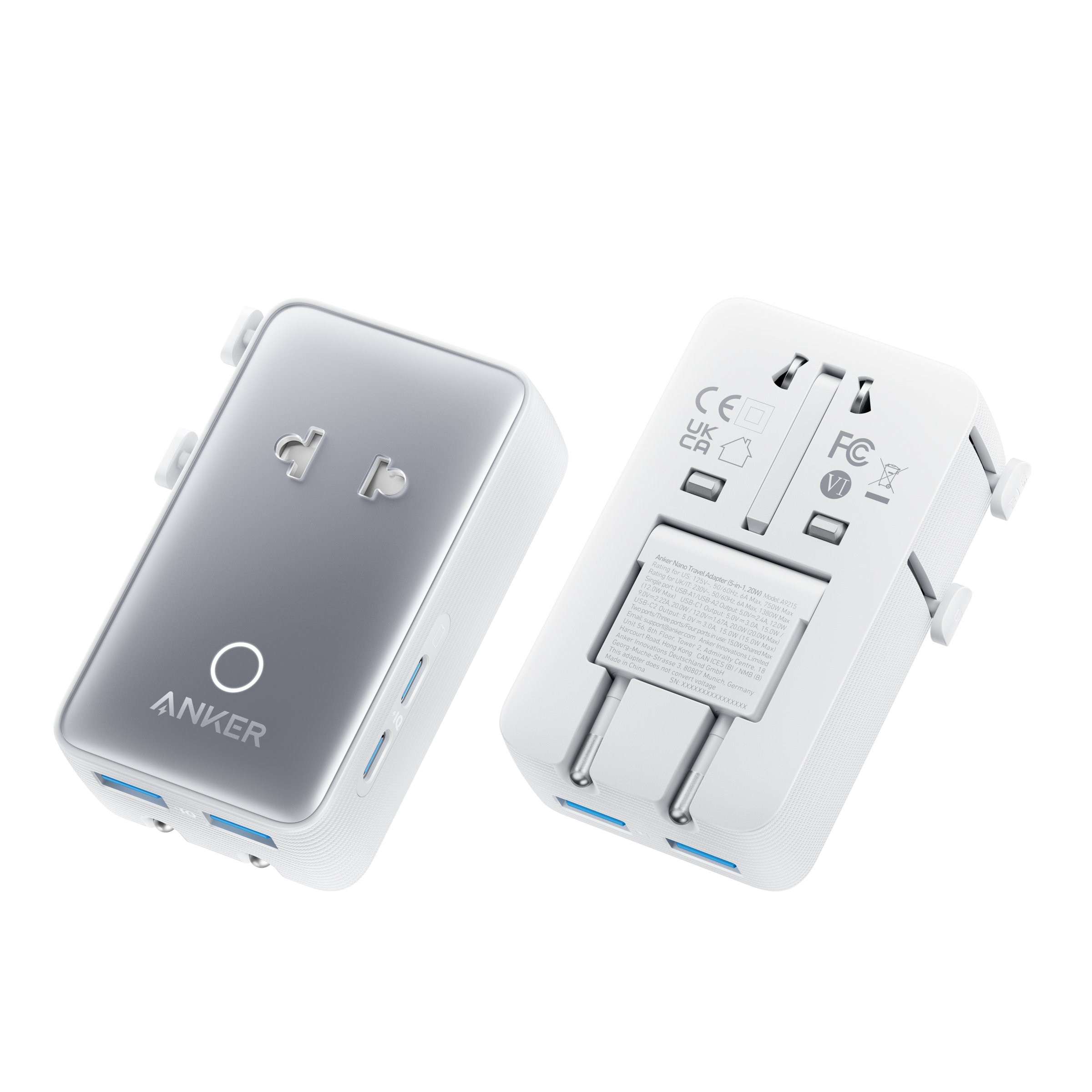
For a compatible wide-input charger, pack the correct plug connection and leave the separate converter behind. If you want USB charging built in, the Anker Nano review covers a compact option; our universal travel adapter guide covers higher-output laptop choices.
For an incompatible or uncertain appliance, resolve that before departure—not at the hotel socket. Once the electrical requirements are settled, the travel charging hub can help trim the chargers and cables in your bag.