Can You Bring a Power Bank on a Plane? 2026 Rules
Yes, you can bring a power bank on a plane, but it belongs in your carry-on. Here are the 2026 capacity, quantity, packing, and in-flight rules.
Quick Take
- Power banks belong in carry-on baggage, never in a checked bag.
- For the simplest rule across U.S. and international trips, carry no more than two power banks and keep each one at or below 100Wh.
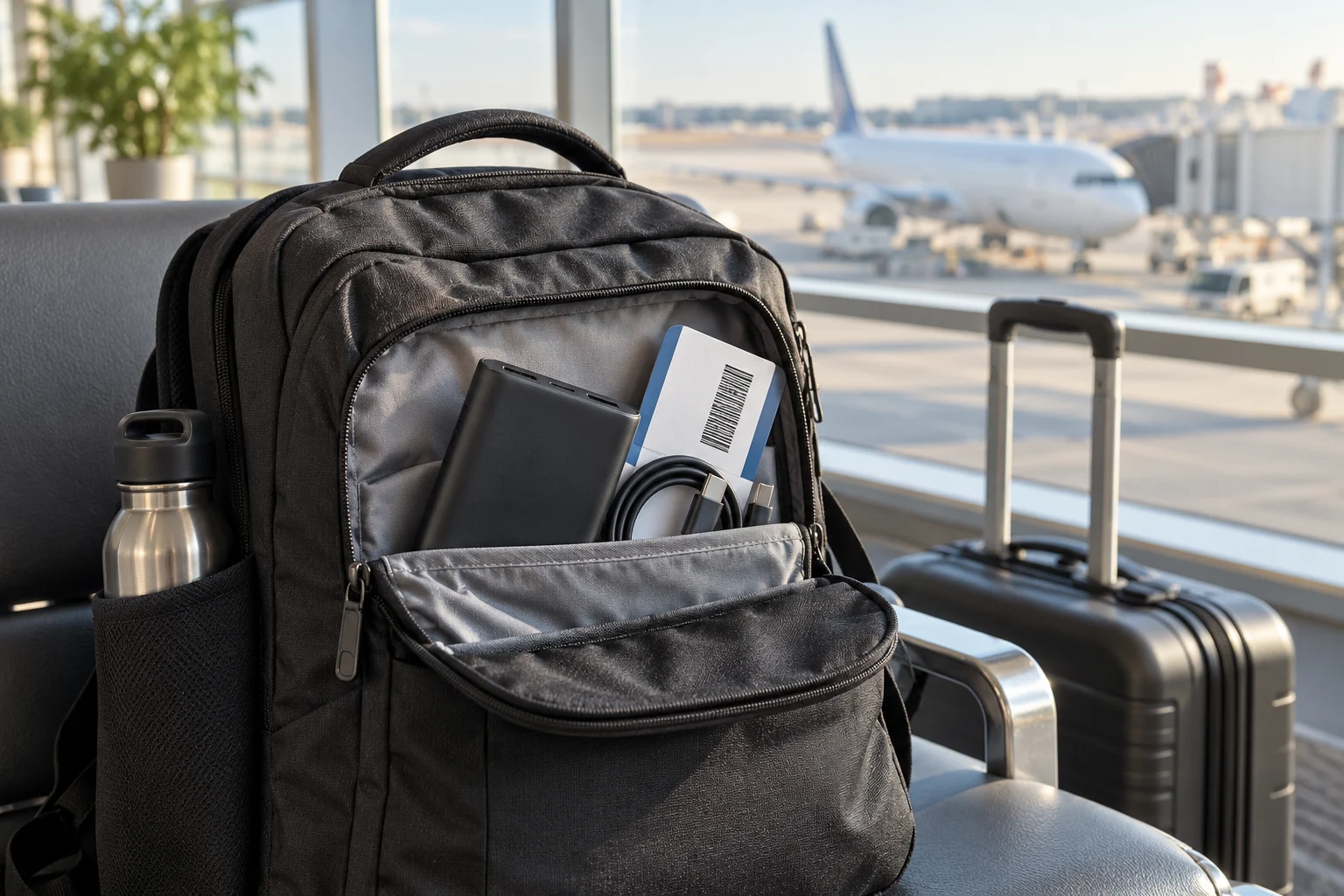
Yes, you can bring a power bank on a plane. It must travel in your carry-on, not your checked bag. A power bank at or below 100 watt-hours is generally allowed, but the number you can carry and whether you can use it in flight now depend on your route and airline.
The safest default for 2026 is simple: pack no more than two power banks, keep each one at or below 100Wh, store them where you can reach them, and check your airline's rules before leaving.
Power Bank Carry-On Rules at a Glance
- Carry-on only: Never put a power bank in checked luggage.
- 100Wh or less: This is the standard no-approval capacity limit.
- U.S. flights: FAA rules allow power banks from 101–160Wh only with airline approval, with a maximum of two in that larger range.
- International travel: The 2026 ICAO change limits passengers to two power banks. Current IATA guidance says each must be 100Wh or less.
- Airlines can be stricter: Your carrier, destination, or route may impose a lower quantity or capacity limit.
- Keep it accessible: IATA advises against storing power banks in an overhead bin.
Are These TSA Rules or FAA Rules?
Calling all of them “TSA power bank rules” is convenient but incomplete.
TSA screens passengers and bags at U.S. airport checkpoints. Its What Can I Bring guidance says power banks can go in carry-on bags but not checked bags, then points travelers to the FAA for the battery limits.
The FAA's PackSafe guidance covers how batteries may travel on U.S. passenger aircraft. ICAO sets international technical instructions, IATA turns those rules into practical airline guidance, and each airline can add stricter requirements.
That is why a power bank may clear TSA screening but still conflict with an airline or international rule.
What Is the Power Bank Limit for U.S. Flights?
FAA guidance divides rechargeable lithium batteries into three capacity bands:
- 0–100Wh: Allowed in carry-on baggage without advance airline approval.
- 101–160Wh: Allowed only with airline approval, with no more than two larger spare batteries or power banks per passenger.
- Over 160Wh: Forbidden in passenger baggage.
For power banks under 100Wh, the FAA does not set a numerical limit when they are for the passenger's personal use. It also warns that airlines can set stricter quantity limits.
What Changed for International Flights in 2026?
An ICAO power-bank update took effect on March 27, 2026. It limits passengers to two power banks and prohibits recharging a power bank during a flight.
IATA's current passenger lithium-battery guidance applies a maximum of two power banks, each no more than 100Wh. It also says power banks should not be stored in overhead bins or used to power another device during taxi, takeoff, or landing.
This is stricter than the U.S. FAA exception for a 101–160Wh power bank. On an international itinerary, do not assume FAA approval makes a battery acceptable for every flight. Check the operating airline for each segment.
How Many Power Banks Can You Bring on a Plane?
For a trip governed only by U.S. rules, the FAA permits a reasonable number of sub-100Wh power banks for personal use. Airlines may still impose their own cap.
For international travel, the current ICAO/IATA framework limits you to two power banks per person, and IATA's 2026 passenger guidance limits each to 100Wh.
If you want one packing rule that works across the widest range of trips, carry one or two power banks below 100Wh. Travelers carrying more should confirm the exact policy with the airline before the trip.
How to Check a Power Bank's Watt-Hour Rating
Look for Wh on the battery label. Use that printed rating when it is available.
If the label shows only milliamp-hours and voltage, calculate watt-hours with:
Wh = (mAh × V) / 1,000
Using a common 3.7V nominal voltage:
- 10,000mAh is about 37Wh
- 20,000mAh is about 74Wh
- 27,000mAh is about 99.9Wh
Those are examples, not substitutes for the actual label. Battery voltage varies, and IATA notes that an airline may refuse a battery when staff cannot verify its Wh rating. Our mAh vs. Wh guide explains the conversion in more detail.
How to Pack a Power Bank for a Flight
Keep the battery in your personal item or carry-on, ideally in a protective pouch where it cannot be crushed or contact loose metal objects. Protect exposed terminals against short circuits. Original packaging, terminal covers, or separate protective bags all work when applicable.
If an agent gate-checks your carry-on, remove the power bank before handing over the bag. It still cannot go into the cargo hold just because the bag was accepted at the gate.
Do not fly with a swollen, punctured, damaged, overheating, or recalled power bank. The FAA prohibits damaged or recalled batteries that could spark or produce dangerous heat. If a battery becomes hot, expands, smokes, or burns during a flight, tell the crew immediately.
Can You Use a Power Bank During the Flight?
Never recharge the power bank itself from an aircraft outlet or USB port. Under the 2026 ICAO change, recharging a power bank in flight is prohibited.
IATA guidance also says not to use a power bank to charge another device during taxi, takeoff, or landing and recommends keeping it out of the overhead bin. Some airlines prohibit power-bank use for the entire flight, so follow the carrier's policy and crew instructions.
The Simple Packing Check
Before leaving for the airport, check four things:
- The power bank is in your carry-on.
- Its printed rating is 100Wh or less.
- You have no more than two for an international trip.
- Your airline does not have a stricter rule.
Need a travel battery that stays under the standard limit? See our best power banks for travel. Rules and airline policies can change, so this guide was checked against FAA, ICAO, IATA, and TSA guidance on October 6, 2026.