EcoFlow RIVER 3 Plus vs Jackery Explorer 300
The EcoFlow RIVER 3 Plus is faster and more capable, while the Jackery Explorer 300 is lighter and gives you two AC outlets.
Quick Take
- Buy the EcoFlow RIVER 3 Plus for its 600W rated AC output, three outlets, faster charging, and extra-battery support.
- Buy the Jackery Explorer 300 when its 7.1-pound weight and second AC outlet matter more than charging speed or expansion.
- Capacity is effectively tied at 286Wh versus 293Wh, so runtime should not decide this comparison.
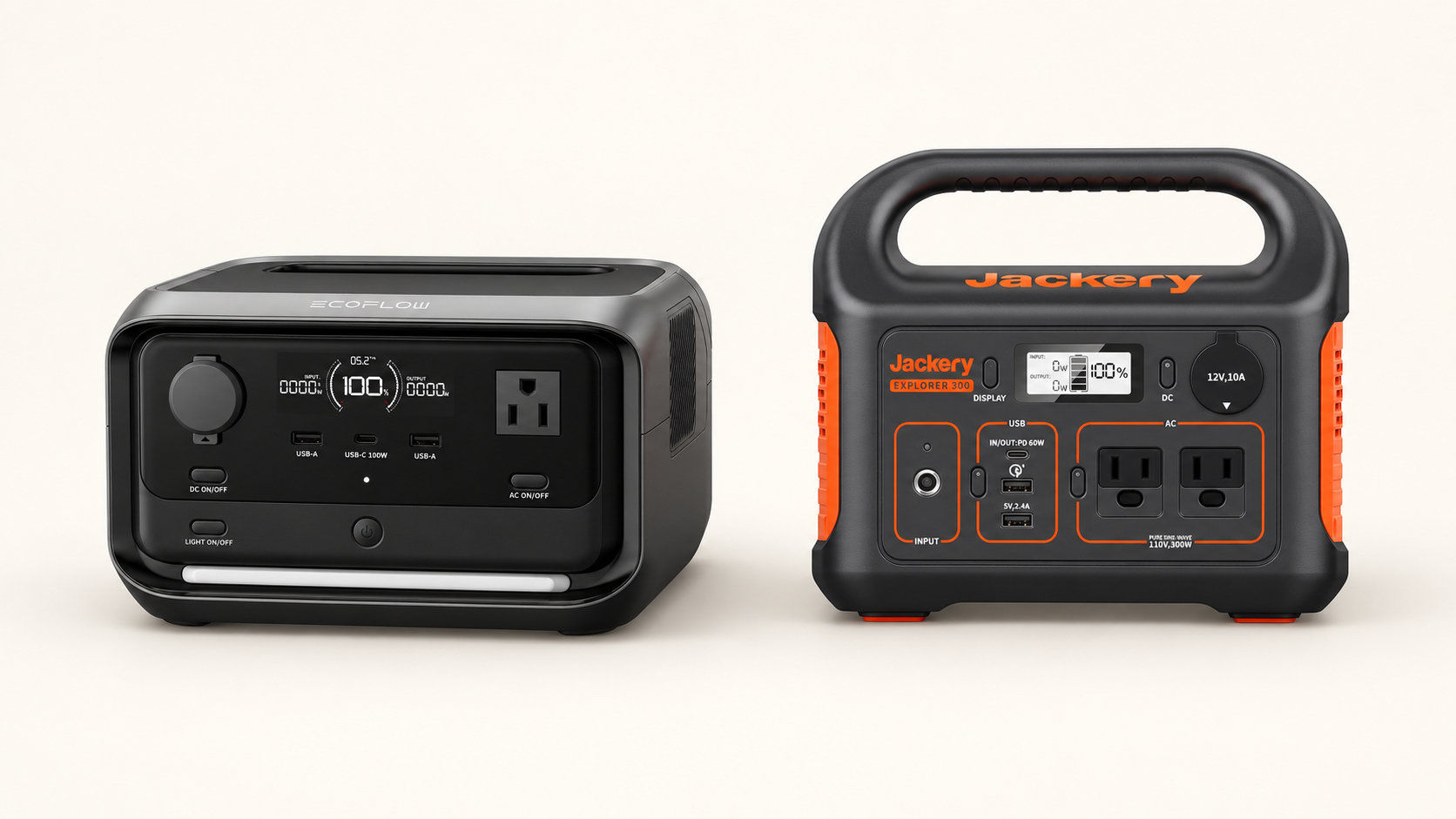
The EcoFlow RIVER 3 Plus is the better choice for most people. It has twice the Jackery's rated AC output, much faster wall charging, a higher-power USB-C port, backup-power switching, and an extra-battery connection.
Choose the Jackery Explorer 300 if portability comes first. It weighs 7.1 pounds, about 3.3 pounds less than the EcoFlow, while storing essentially the same amount of energy. It also gives you two AC outlets instead of one, though both share the same 300W inverter limit.
EcoFlow RIVER 3 Plus vs Jackery Explorer 300 specs
EcoFlow's current RIVER 3 Plus specifications and Jackery's official Explorer 300 product page confirm the main differences:
- Capacity: EcoFlow: 286Wh; Jackery: 293Wh
- Rated AC output: EcoFlow: 600W; Jackery: 300W
- Surge rating: EcoFlow: 1,200W; Jackery: 500W
- AC outlets: EcoFlow: three; Jackery: two
- USB: EcoFlow: one 100W USB-C and two 12W USB-A ports; Jackery: one 60W USB-C input/output, one 18W Quick Charge USB-A, and one 12W USB-A port
- Claimed wall recharge: EcoFlow: 60 minutes; Jackery: 4.5 hours, or 2.5 hours when combining its wall adapter and USB-C input
- Backup transfer: EcoFlow: under 10ms; Jackery: no EPS mode
- Weight: EcoFlow: 10.4 lb; Jackery: 7.1 lb
- Dimensions: EcoFlow: 9.2 × 9.1 × 5.8 in; Jackery: 9.1 × 5.2 × 7.8 in
- Expansion: EcoFlow accepts an EB300 or EB600 battery; Jackery does not support an extra battery
The battery chemistry is different too. EcoFlow uses LiFePO4 cells rated for 3,000 cycles to 80% capacity. Jackery uses an older lithium-ion pack rated for 800 cycles to 80%. Both include a car outlet, but only EcoFlow has app control and a built-in light.
EcoFlow Gives You More AC Headroom
The EcoFlow's 600W rated inverter is its strongest advantage. It can handle loads that exceed the Jackery's 300W ceiling, and its three AC outlets leave room for a few small devices without adding a power strip.
The Jackery has two AC outlets, but they still share a 300W ceiling. That is enough for chargers, lights, a small fan, and many electronics, but it leaves much less margin for a projector, kitchen device, or several loads at once. Its 500W surge figure covers short startup demand; it does not make the unit a 500W continuous power station.
EcoFlow advertises a 1,200W surge rating and X-Boost support for some higher-wattage heating devices. X-Boost lowers voltage to keep compatible loads running, so it should not be treated as a substitute for a normal 1,200W inverter. Plan around 600W on the EcoFlow and 300W on the Jackery.
Capacity does not change the result. The Jackery's 293Wh battery is only 7Wh larger than EcoFlow's 286Wh battery, a difference too small to matter in real use. Actual runtime will depend on the load, conversion losses, temperature, and each station's low-load efficiency.
Jackery Is Easier to Carry
The Explorer 300 weighs 7.1 pounds, compared with 10.4 pounds for the RIVER 3 Plus. Saving roughly 3.3 pounds is noticeable when the station goes in a vehicle, camera kit, or campsite setup every weekend.
Jackery's tall handle also makes its purpose obvious: this is the grab-and-go option. The body is narrower and shallower than EcoFlow's, although it is slightly taller. If your typical load is a phone, laptop, camera, drone battery, light, or small fan, the 300W limit may be an acceptable trade for the lower weight.
The USB layout favors EcoFlow. Its 100W USB-C port can charge a more demanding laptop, while Jackery's only USB-C port tops out at 60W and also serves as a charging input. Jackery adds one Quick Charge 3.0 USB-A port and one standard 12W USB-A port. Neither station gives you two high-power USB-C outputs.
EcoFlow Recharges Faster
EcoFlow rates the RIVER 3 Plus for a full wall recharge in 60 minutes. Jackery lists 4.5 hours from its wall adapter alone. You can cut that to about 2.5 hours by using the wall adapter and 60W USB-C input together, but that requires two power sources. Those are manufacturer claims under controlled conditions, yet the difference is large enough to matter during a short grid-power window or between travel stops.
Solar input follows the same pattern. EcoFlow accepts up to 220W and claims a recharge as fast as 1.5 hours with sufficient input. Jackery pairs the Explorer 300 with its SolarSaga 100 panel and lists about five hours for a full solar recharge in good conditions.
EcoFlow also offers an EPS mode with a transfer time under 10ms. The Explorer 300 does not have an equivalent backup-power mode. EcoFlow is not a zero-transfer online UPS, so sensitive equipment should still be tested before relying on it.
Only the EcoFlow Can Add Capacity
The RIVER 3 Plus accepts one stackable EcoFlow battery. An EB300 brings total capacity to 572Wh, while an EB600 raises it to 858Wh. Our RIVER 3 Plus vs RIVER 3 Max comparison explains the EB300 configuration and why capacity increases without changing the base station's 600W inverter.
The Explorer 300 does not support an extra battery. If 293Wh becomes too limiting, the practical upgrade is a different power station rather than an add-on module.
Expansion is not automatically a reason to buy EcoFlow. Another battery adds cost and weight, and buyers who already need much more runtime may be better served by a larger one-piece station. Our RIVER 3 Plus vs RIVER 2 Pro comparison covers a 768Wh alternative, while the compact portable power station guide compares more brands in this size range.
Which One Should You Buy?
Buy the EcoFlow RIVER 3 Plus if this will do more than charge small electronics. Its 600W output, three outlets, 220W solar input, one-hour AC recharge claim, and expansion path make it the more capable camping and light-backup power station.
Buy the Jackery Explorer 300 if you know your combined AC loads fit below 300W and you will carry the station often. It gives you nearly identical battery capacity, two AC outlets, and saves about 3.3 pounds, but it charges more slowly and uses shorter-lived lithium-ion cells.
If EcoFlow's phone-charging dock is part of the appeal, the Costco RIVER 3 Plus Wireless Boost Combo review covers that separate bundle. Its dock and removable phone batteries do not change the basic 286Wh capacity class.
The Bottom Line
The EcoFlow RIVER 3 Plus and Jackery Explorer 300 store almost the same amount of energy. EcoFlow gives that battery a stronger inverter, faster input, newer battery chemistry, backup switching, and an upgrade path. Jackery gives you a lighter body and a second AC outlet.
Choose the EcoFlow by default. Choose the Jackery when saving about 3.3 pounds and plugging in two small AC devices matter more than doubling AC output or cutting recharge time.
Affiliate disclosure: We may earn a commission if you buy through our links at no extra cost to you.