EcoFlow RIVER 3 Plus vs RIVER 2 Pro: Which Should You Buy?
The RIVER 2 Pro is better for longer outages and heavier loads. The RIVER 3 Plus is much easier to carry and has the stronger UPS setup.
Quick Take
- Buy the RIVER 2 Pro when 768Wh of capacity and 800W of rated AC output matter more than weight.
- Buy the RIVER 3 Plus for a 10.4-pound station with faster UPS switching, a quiet low-load design, and an expansion path.
- The newer model name is misleading here. The RIVER 3 Plus is a smaller capacity class, not a direct replacement for the RIVER 2 Pro.
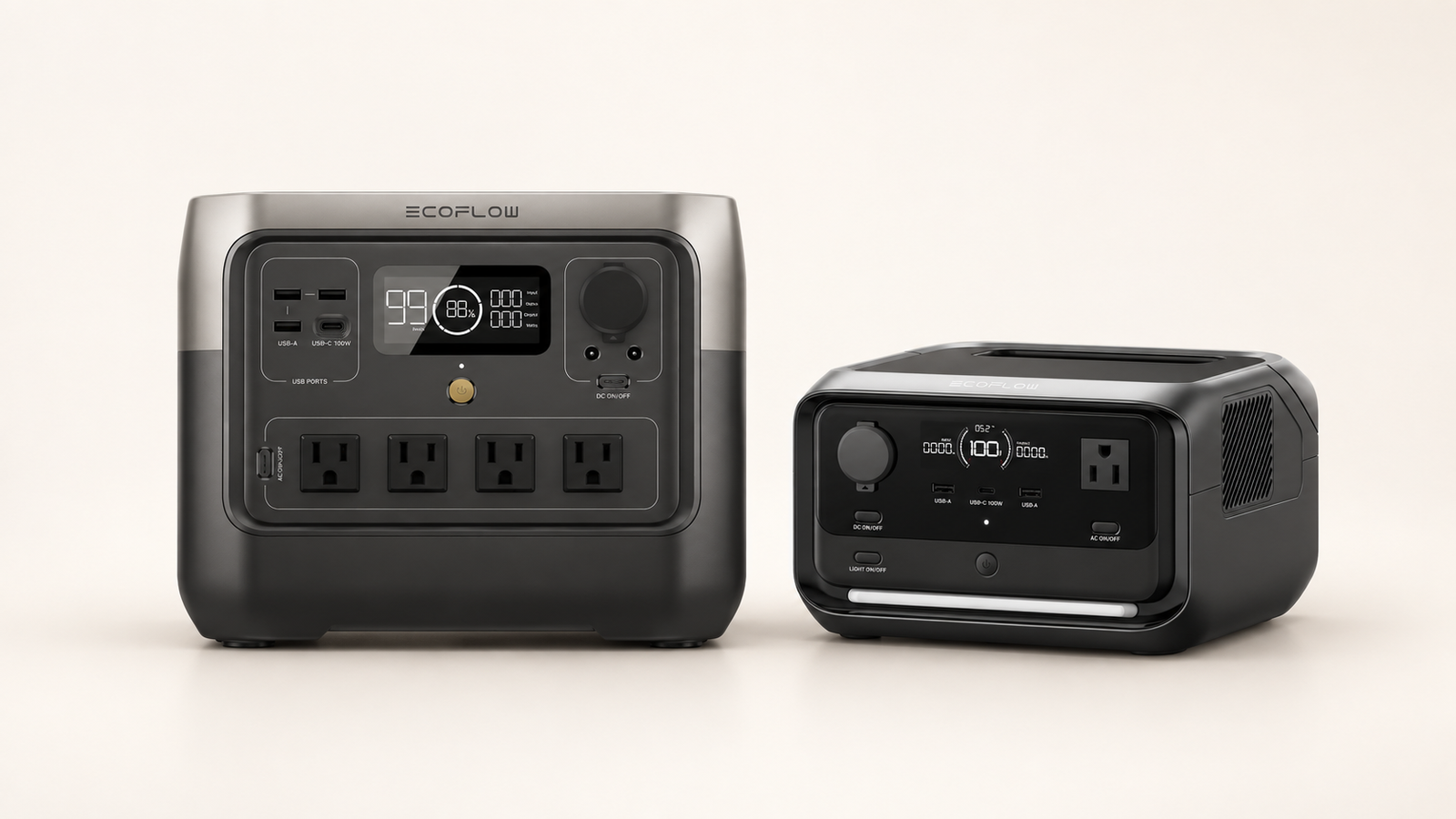
The EcoFlow RIVER 2 Pro is the better choice for most backup-power buyers. Its 768Wh battery holds nearly 2.7 times as much energy as the 286Wh RIVER 3 Plus, and its 800W rated AC output gives appliances more headroom. If the goal is keeping essentials running through a longer outage, those advantages matter more than the generation number.
Choose the RIVER 3 Plus when you will carry the station often or leave it under a desk as a UPS. It weighs 7.8 pounds less, switches to battery faster, and can grow to 858Wh with an extra battery. It is the more flexible small station, but it is not a smaller replacement for the RIVER 2 Pro's capacity.
EcoFlow RIVER 3 Plus vs RIVER 2 Pro Specs
These figures come from EcoFlow's current US product pages and the model-specific RIVER 3 Plus and RIVER 2 Pro manuals.
- Capacity: RIVER 3 Plus: 286Wh; RIVER 2 Pro: 768Wh
- Rated AC output: RIVER 3 Plus: 600W; RIVER 2 Pro: 800W
- X-Boost: RIVER 3 Plus: up to 1,200W; RIVER 2 Pro: up to 1,600W
- Weight: RIVER 3 Plus: 10.4 lb; RIVER 2 Pro: 18.2 lb
- Dimensions: RIVER 3 Plus: 9.2 × 9.1 × 5.8 in; RIVER 2 Pro: 10.6 × 10.2 × 8.9 in
- Solar input: 220W maximum for both
- AC recharge claim: RIVER 3 Plus: 60 minutes; RIVER 2 Pro: 70 minutes
- Backup transfer: RIVER 3 Plus: under 10ms; RIVER 2 Pro: within 30ms
- Expansion: RIVER 3 Plus: up to 858Wh; RIVER 2 Pro: no direct extra-battery connection
Both use LiFePO4 batteries rated to retain at least 80 percent capacity after 3,000 cycles. Both also provide two 12W USB-A ports, one 100W USB-C port, app control, a car outlet, and four charging methods. Capacity, output, carry weight, UPS behavior, and expansion should decide this comparison.
The RIVER 2 Pro Is Built for Longer Outages
The capacity gap is the main story. The RIVER 2 Pro stores 768Wh, compared with 286Wh in the RIVER 3 Plus. That is a 482Wh advantage before inverter losses and operating conditions enter the picture.
I would take the RIVER 2 Pro for a refrigerator, router, longer campsite stay, or a backup setup that needs to cover several devices. Exact runtime depends on the load and efficiency, so a single hours estimate would be misleading. The larger battery simply starts with far more energy.
The RIVER 2 Pro also has the stronger inverter. Its 800W rated output offers 200W more headroom than the RIVER 3 Plus. EcoFlow advertises X-Boost limits of 1,600W and 1,200W, respectively, but those modes lower voltage for compatible heating and motor-driven appliances. Plan around 800W or 600W of normal output and treat X-Boost as device-dependent flexibility.
The RIVER 3 Plus Is Much Easier to Carry
The RIVER 3 Plus weighs 10.4 pounds. The RIVER 2 Pro weighs 18.2 pounds. Saving 7.8 pounds is a meaningful difference if the station moves between a desk, car, campsite, and closet instead of staying beside an emergency kit.
It is smaller in every dimension too, with a particularly shallow 5.8-inch body. The RIVER 2 Pro is not enormous, but its deeper, taller case belongs to a different capacity class.
Port layout is not a reason to choose the larger model. Both cover the basics with two USB-A ports, one 100W USB-C port, AC outlets, and a 12V car socket. The US RIVER 2 Pro has four AC outlets while the RIVER 3 Plus has three, but total rated output matters more than the socket count.
The RIVER 3 Plus Has the Better UPS Setup
EcoFlow rates the RIVER 3 Plus to switch to battery in under 10ms, versus within 30ms for the RIVER 2 Pro. The newer station also has a data connection for EcoFlow Power Manager, which can monitor a computer or NAS and trigger a safe shutdown when the battery runs low.
Neither offers zero-transfer online UPS protection. Test your exact equipment before trusting either station with a sensitive load, and do not use a portable power station as a substitute for required medical or safety equipment.
The RIVER 3 Plus is also the more desk-friendly design. EcoFlow publishes a controlled-test noise claim below 30 dB and emphasizes better efficiency with tiny loads such as a router or light. EcoFlow's RIVER 2 Pro specifications instead warn that high-wattage charging and discharging can reach 62 dB. Those are not matching test conditions, so they do not prove the Plus is always quieter, but the smaller station is clearly designed around low-load backup use.
Charging Speed Is Close, but Only the RIVER 3 Plus Expands
Both accept up to 220W of solar input. The RIVER 3 Plus can recharge from AC in a claimed 60 minutes, while the RIVER 2 Pro takes 70 minutes. That ten-minute gap is minor compared with the difference in battery size.
Expansion changes the longer-term calculation. The RIVER 3 Plus accepts either EcoFlow's 286Wh EB300 or 572Wh EB600 Smart Extra Battery. The EB600 brings total capacity to 858Wh, slightly more than the RIVER 2 Pro, while preserving the option to carry the smaller station by itself.
That does not make the RIVER 3 Plus the automatic winner. Expansion adds another battery, more weight, and more cost. Buy the RIVER 2 Pro if you already know you need roughly 768Wh in one box. Buy the RIVER 3 Plus if you want a lighter base station now and a path to add capacity later.
Where the Costco RIVER 3 Plus Wireless Bundle Fits
Costco's RIVER 3 Plus Wireless Boost Combo keeps the same basic 286Wh, 600W capacity class but adds a magnetic charging surface and two detachable EcoFlow RAPID power banks. Our Costco RIVER 3 Plus Wireless review explains why that makes the station more useful day to day.
The bundle does not close the runtime gap with the RIVER 2 Pro. Choose it for the charging-dock setup, not because the word Wireless implies a larger power station. If you are still deciding between the standard RIVER 3 models, start with our RIVER 3 vs RIVER 3 Plus comparison. The BLUETTI Elite 30 V2 vs RIVER 3 Plus Wireless comparison covers the closer 600W Costco matchup.
Which EcoFlow RIVER Should You Buy?
Buy the RIVER 2 Pro if outage runtime and appliance headroom come first. Its 768Wh battery and 800W inverter make it the safer default for home backup, longer camping trips, and jobs that would quickly drain a 286Wh station.
Buy the RIVER 3 Plus if portability or UPS use comes first. It is 7.8 pounds lighter, switches faster, is designed for quiet low-load operation, and leaves room for a stackable battery later.
The Bottom Line
Do not read RIVER 3 Plus as a straight upgrade over RIVER 2 Pro. The newer model improves portability, UPS behavior, and expansion, but it starts with far less battery capacity and slightly less rated output.
For general backup power, buy the RIVER 2 Pro. Pick the RIVER 3 Plus when you specifically want the lighter station or the stronger desk-UPS setup.
Affiliate disclosure: We may earn a commission if you buy through our links at no extra cost to you.