EcoFlow RIVER 3 vs RIVER 3 Plus: Which One Should You Buy?
The RIVER 3 is lighter and enough for small electronics. The RIVER 3 Plus is worth it for 600W output, faster UPS switching, more solar input, and expansion.
Quick Take
- The RIVER 3 is the better lightweight choice for phones, laptops, lights, routers, and other loads that stay below its 300W rated output.
- The RIVER 3 Plus is the better default buy because it doubles rated AC output to 600W, adds a third AC outlet, and accepts twice as much solar input.
- Only the RIVER 3 Plus supports EcoFlow's stackable extra batteries, so it can grow from 286Wh to 858Wh.
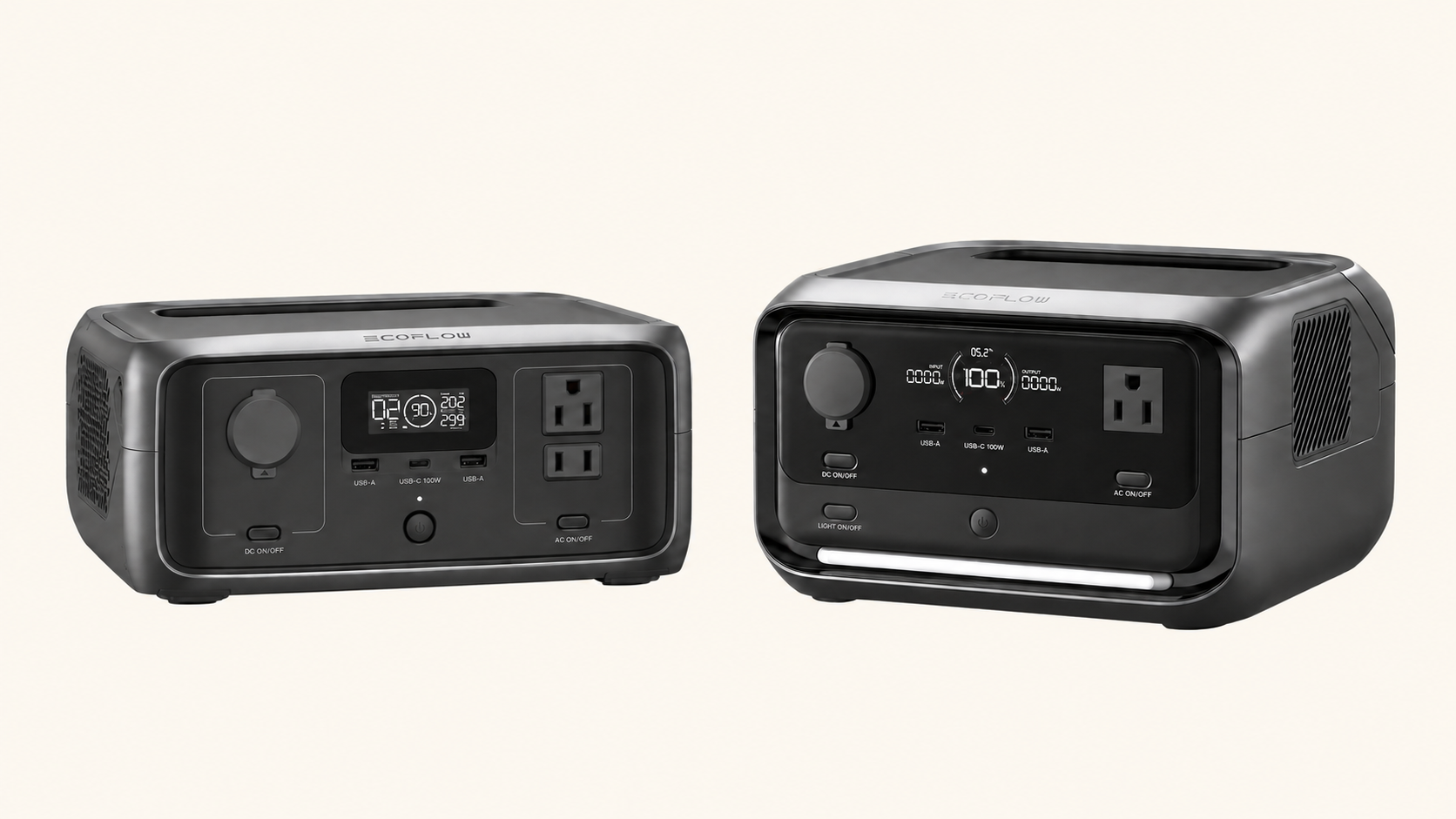
The EcoFlow RIVER 3 Plus is the better buy for most people. Its battery is only modestly larger than the regular RIVER 3, but it doubles rated AC output from 300W to 600W, adds another AC outlet, accepts twice as much solar input, switches to battery faster in UPS mode, and supports stackable extra batteries.
Choose the regular RIVER 3 when portability matters more than headroom. It weighs 7.8 pounds instead of 10.4 pounds and covers the same basic phone, laptop, router, light, and camera-charging jobs as long as the combined AC load stays below 300W.
EcoFlow RIVER 3 vs RIVER 3 Plus Specs
The numbers below come from EcoFlow's current US product specifications and the model-specific RIVER 3 and RIVER 3 Plus manuals.
- Capacity: RIVER 3: 245Wh; RIVER 3 Plus: 286Wh
- Rated AC output: RIVER 3: 300W; RIVER 3 Plus: 600W
- X-Boost: RIVER 3: up to 600W; RIVER 3 Plus: up to 1,200W
- AC outlets: RIVER 3: 2; RIVER 3 Plus: 3
- USB ports: Both have two 12W USB-A ports and one 100W USB-C port
- Solar input: RIVER 3: 110W; RIVER 3 Plus: 220W
- UPS transfer claim: RIVER 3: under 20ms; RIVER 3 Plus: under 10ms
- AC recharge claim: 0–100% in 60 minutes for both
- Weight: RIVER 3: 7.8 lb; RIVER 3 Plus: 10.4 lb
- Dimensions: RIVER 3: 10 × 8.3 × 4.4 in; RIVER 3 Plus: 9.2 × 9.1 × 5.8 in
- Expansion: RIVER 3: none; RIVER 3 Plus: up to 858Wh
Both use LiFePO4 batteries rated to retain at least 80% capacity after 3,000 cycles. EcoFlow also rates both below 30 dB under its stated test conditions. Those shared traits should not decide the comparison; output and expansion are the meaningful differences.
The RIVER 3 Plus Handles More Useful Loads
The regular RIVER 3's 300W inverter is enough for small electronics. A router, laptop, monitor, camera charger, lights, or a compact fan fits its purpose. It is a poor match for anything that regularly pushes past 300W.
The RIVER 3 Plus raises rated output to 600W and X-Boost support to 1,200W. That gives it much more breathing room for a larger office setup or other moderate loads, especially when several devices share the three AC outlets.
X-Boost is not the same as 1,200W of normal AC output. EcoFlow says it is intended for compatible heating and motor-driven devices and may lower voltage to keep them running. Electronics with voltage protection may not work properly in that mode. Plan around the 600W rated output, then treat X-Boost as device-dependent flexibility.
The Capacity Difference Is Smaller Than the Output Difference
The Plus name does not mean dramatically longer runtime out of the box. Its 286Wh battery is only 41Wh larger than the RIVER 3's 245Wh battery. For the same light load, that is a useful but modest increase.
The real long-runtime advantage is expansion. The RIVER 3 Plus accepts one EcoFlow EB300 or EB600 Smart Extra Battery through its bottom connector. The larger EB600 takes total capacity to 858Wh. The regular RIVER 3 has no equivalent expansion port, so its 245Wh capacity is fixed.
Buy for the job you actually have. If a small power station only needs to keep a router and laptop alive briefly, the regular model's fixed capacity may be enough. If this could become part of a longer home-backup setup, the Plus avoids a dead end.
The Plus Is Better for Solar and UPS Use
Both models can recharge from a wall outlet in one hour, so the Plus is not meaningfully faster at home. Solar is different: the RIVER 3 accepts up to 110W, while the RIVER 3 Plus accepts up to 220W. EcoFlow quotes best-case full solar recharge times of 2.6 hours and 1.5 hours, respectively.
The RIVER 3 Plus also has the stronger official UPS specification. EcoFlow rates its transfer time below 10ms, compared with below 20ms for the standard RIVER 3. The Plus adds a USB-B communication port for EcoFlow Power Manager, which can monitor a connected computer or NAS and trigger an orderly shutdown when the battery runs low.
That makes the Plus the clearer choice for a desk, network closet, or NAS setup. It is still a standby UPS, not a substitute for purpose-built medical or safety equipment, and compatibility depends on the connected hardware.
The RIVER 3 Wins on Carry Weight
The RIVER 3 is 2.6 pounds lighter and 1.4 inches shorter. Its body is slightly wider, but the flatter shape is easier to slide onto a shelf or pack with camping gear. If every pound matters and your loads are predictable, that is a real advantage.
The RIVER 3 Plus is squarer and heavier, though 10.4 pounds is still easy to move around a home or campsite. The extra weight buys the stronger inverter, third AC outlet, faster solar input, better UPS specification, built-in strip light, and battery-expansion connector.
What About the RIVER 3 Plus Wireless Bundle?
The RIVER 3 Plus Wireless is a separate variant, not another name for the plain RIVER 3 Plus in this comparison. If you are a Costco member, consider the Costco RIVER 3 Plus Wireless Boost Combo before buying the standard Plus. It adds a magnetic charging surface and two detachable EcoFlow RAPID power banks, making it more useful as an everyday charging dock.
That bundle keeps the Plus model's broader power-station appeal, but its value depends on whether you want the phone batteries. Our BLUETTI Elite 30 V2 vs RIVER 3 Plus Wireless comparison covers that specific Costco matchup. Do not pay for the Wireless package if all you need is the standard Plus power station.
Which EcoFlow RIVER 3 Should You Buy?
Buy the EcoFlow RIVER 3 if you want the lightest, simplest option for small electronics and know your AC load will remain below 300W. It does the core charging jobs, has the same 100W USB-C output and one-hour wall recharge claim, and saves 2.6 pounds.
Buy the EcoFlow RIVER 3 Plus if this will cover more than a basic travel kit. Double the rated AC output matters more than the small capacity increase, and the faster UPS transfer, 220W solar input, third AC outlet, and expansion support make it much harder to outgrow.
The Bottom Line
The RIVER 3 is a good lightweight power station for fixed, modest loads. The RIVER 3 Plus is the smarter default because it gives you twice the rated AC output and a real upgrade path without becoming difficult to carry.
Unless saving 2.6 pounds is the priority, buy the RIVER 3 Plus. Costco members should also compare it with the Wireless Boost Combo, especially if the two grab-and-go phone batteries would get regular use.
Affiliate disclosure: We may earn a commission if you buy through our links at no extra cost to you.