EcoFlow RIVER 3 Plus vs RIVER 3 Plus Wireless: Which One Should You Buy?
The RIVER 3 Plus Wireless adds a dock for EcoFlow RAPID phone batteries, but the regular RIVER 3 Plus is the better default if you only need a compact power station.
Quick Take
- The regular RIVER 3 Plus is the better default because its power-station performance matches the Wireless model without the heavier docking hardware.
- Choose the Wireless Boost Combo if you will regularly use its two dockable 5,000mAh RAPID magnetic power banks.
- Both models have a 286Wh battery, 600W rated output, under-10ms UPS transfer, 220W solar input, and support for EcoFlow's EB300 or EB600 extra battery.
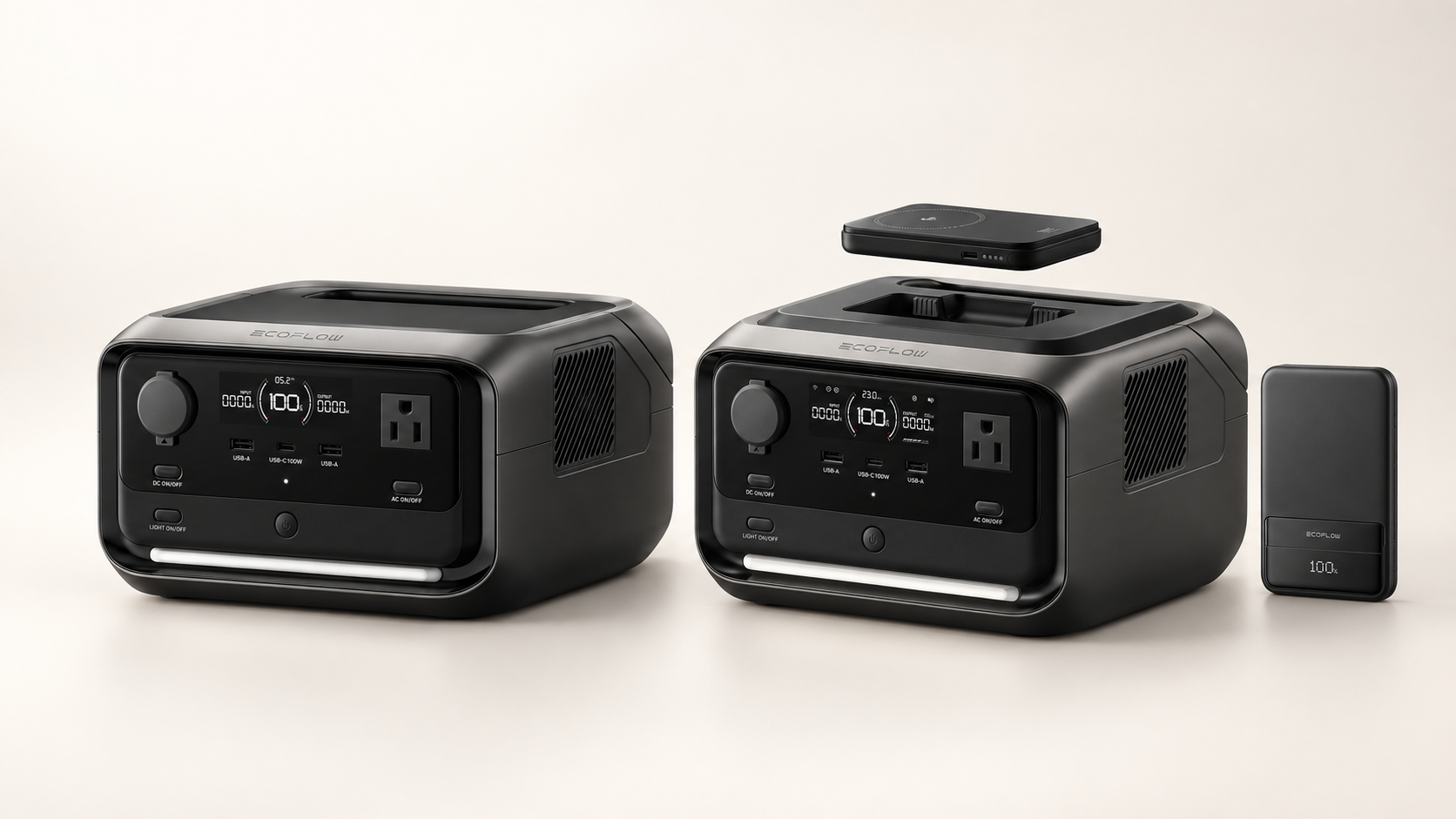
The regular EcoFlow RIVER 3 Plus is the better buy for most people. It has the same 286Wh capacity, 600W rated output, charging inputs, UPS behavior, ports, and extra-battery support as the RIVER 3 Plus Wireless. It is also 1.1 pounds lighter.
Buy Costco's RIVER 3 Plus Wireless Boost Combo if you will actually use its two detachable 5,000mAh RAPID magnetic power banks. The dock keeps one bank charged without a cable, and that bank can deliver 15W Qi2 wireless or 30W wired charging. This is a phone-charging upgrade, not a more capable power station.
RIVER 3 Plus vs RIVER 3 Plus Wireless Specs
EcoFlow's model-specific RIVER 3 Plus and RIVER 3 Plus Wireless manuals show how much these units share:
- Capacity: 286Wh each
- Rated AC output: 600W each; X-Boost supports certain heating and motor-driven devices up to 1,200W
- AC outlets: 3 each on the US models
- USB: Two 12W USB-A ports and one 100W USB-C port each
- Car output: 126W each
- Solar input: 220W each
- AC recharge claim: 0–100% in 60 minutes for both
- UPS transfer claim: Under 10ms for both
- Expansion: Both accept one EB300 or EB600, raising total capacity to 572Wh or 858Wh
- Station weight: RIVER 3 Plus: 10.36 lb; Wireless: 11.46 lb
- Dimensions: RIVER 3 Plus: 9.21 × 9.13 × 5.75 in; Wireless: 9.21 × 9.13 × 5.98 in
Both use LiFePO4 cells rated to retain at least 80% capacity after 3,000 cycles. Both also support EcoFlow's Power Manager connection for a computer or NAS. Capacity, inverter power, UPS use, and expandability should not decide this comparison because neither model has an advantage there.
The Wireless Model Adds a Phone-Battery Dock
The Wireless station replaces the regular model's plain recessed top with a pogo-pin dock. EcoFlow rates that connector at 12V/2A, or 24W, and the station charges a compatible RAPID bank whenever the station is on and the bank is not full.
Costco's Boost Combo includes two compatible 5,000mAh RAPID magnetic power banks. EcoFlow's RAPID specifications list a built-in USB-C cable, a second USB-C port, up to 30W wired input and output, and 15W Qi2 wireless output. One bank can remain on the station while the other travels with you.
That is useful if you already carry a magnetic phone battery. The station becomes a charging home base, and a phone can charge wirelessly from the docked bank. The small banks remain separate phone batteries, though. They do not increase the power station's 286Wh capacity or replace the EB300 and EB600 expansion batteries.
Our Costco RIVER 3 Plus Wireless Boost Combo review goes deeper on that daily-use setup. This comparison is simpler: the dock is the only reason to choose the Wireless station over the regular Plus.
The Regular RIVER 3 Plus Is Easier to Carry
The Wireless station weighs 11.46 pounds, versus 10.36 pounds for the regular model. Its footprint is effectively identical, but the docking top makes it 0.23 inches taller before a power bank is attached.
A 1.1-pound difference is not dramatic around the house. It matters more when the main reason to buy a 286Wh station is portability. The two bundled RAPID banks add more gear to keep track of, so the Wireless combo makes sense only when those batteries have a regular job.
If you are still deciding whether the 600W Plus is necessary at all, our RIVER 3 vs RIVER 3 Plus comparison covers the larger differences in output, solar input, UPS transfer, and expansion support. Those differences matter much more than the dock.
Which EcoFlow RIVER 3 Plus Should You Buy?
Buy the regular RIVER 3 Plus if you want a compact power station for backup, camping, or a desk UPS. It delivers all of the Wireless model's core power-station capability in a lighter body, and you are not paying for a charging system you may ignore.
Buy the RIVER 3 Plus Wireless Boost Combo if two magnetic phone batteries already fit your routine. It is particularly sensible for a shared household, where one bank can stay ready while the other is in use. Costco is also the exact retailer for this two-bank bundle, so compare the live bundle offer with the regular model before ordering.
If you are considering a different compact station altogether, our BLUETTI Elite 30 V2 vs RIVER 3 Plus Wireless comparison covers the tradeoff between EcoFlow's dock and BLUETTI's lighter, more USB-C-focused design.
The Bottom Line
The RIVER 3 Plus Wireless is not a stronger RIVER 3 Plus. It is the same compact power-station platform with a heavier top dock and two useful phone batteries in Costco's Boost Combo.
Choose the regular RIVER 3 Plus by default. Choose the Wireless combo only when its cable-free charging dock and two RAPID banks will be part of your everyday setup.
Affiliate disclosure: We may earn a commission if you buy through our links at no extra cost to you.