EcoFlow RIVER 3 Plus vs RIVER 3 Max: Which Should You Buy?
The RIVER 3 Max doubles the RIVER 3 Plus's capacity by adding an EB300 battery. Buy the Max for longer runtime, not more AC output.
Quick Take
- The RIVER 3 Plus is the better default because it has the same 600W inverter, base-station ports, UPS behavior, and solar input in a much lighter package.
- The RIVER 3 Max is a RIVER 3 Plus stacked on an EB300 Smart Extra Battery, raising capacity from 286Wh to 572Wh.
- Buy the Max only when roughly double the stored energy is worth carrying about 7.7 extra pounds.
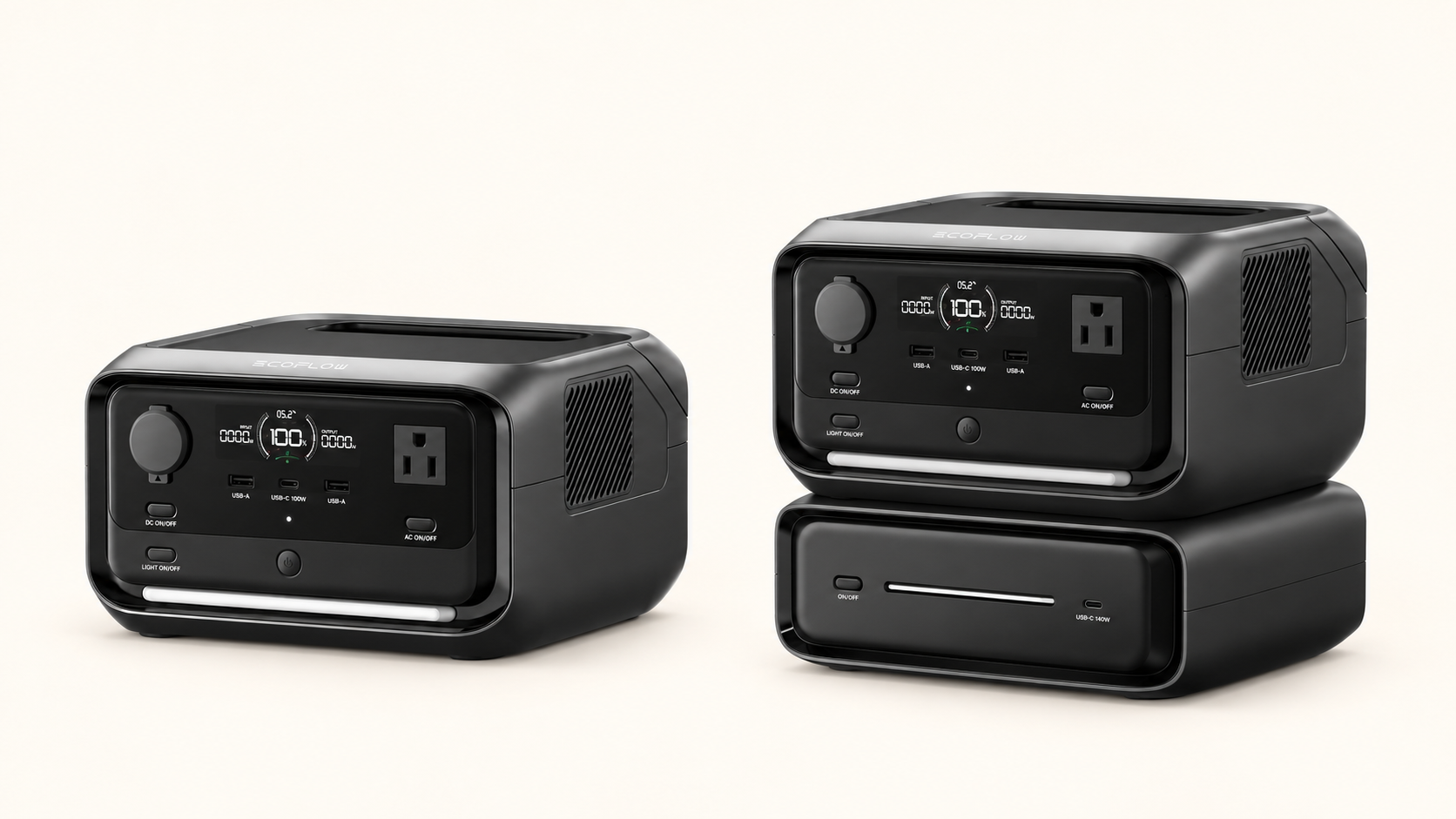
The EcoFlow RIVER 3 Plus is the better buy for most people. It has the same 600W rated AC output, base-station ports, UPS transfer time, app features, and 220W solar-input limit as the RIVER 3 Max, but it weighs far less and is easier to carry.
Choose the RIVER 3 Max when runtime matters more than portability. It combines the 286Wh RIVER 3 Plus with EcoFlow's 286Wh EB300 Smart Extra Battery, bringing total capacity to 572Wh. That is the meaningful upgrade: more stored energy, not a stronger inverter.
RIVER 3 Plus vs RIVER 3 Max Specs
EcoFlow's RIVER 3 Series documentation, model-specific RIVER 3 Plus manual, and EB300 product specifications confirm the differences:
- Capacity: RIVER 3 Plus: 286Wh; RIVER 3 Max: 572Wh
- Rated AC output: 600W each; X-Boost supports certain heating and motor-driven devices up to 1,200W
- Base-station outlets: Three AC outlets, two 12W USB-A ports, one 100W USB-C port, and one 126W car outlet on both
- Extra battery port: The Max's EB300 adds one bidirectional 140W USB-C port
- Solar input: 220W maximum through the RIVER 3 Plus on both configurations
- UPS transfer claim: Under 10ms for both
- Weight: RIVER 3 Plus: 10.4 lb; RIVER 3 Max: about 18.1 lb using EcoFlow's US component weights
- Dimensions: RIVER 3 Plus: 9.2 × 9.1 × 5.8 in; the EB300 adds a 9.2 × 8.8 × 4.3 in stackable module
- Battery: LiFePO4 cells rated to retain at least 80% capacity after 3,000 cycles in both components
- Warranty: Five years for the RIVER 3 Plus and EB300 under EcoFlow's current US warranty policy
The Max package includes the RIVER 3 Plus and EB300. It is not a separate 572Wh power station with a different inverter or port layout.
The Max Doubles Capacity, Not Output
The RIVER 3 Max stores exactly twice as much energy: 572Wh instead of 286Wh. EcoFlow's controlled runtime examples reflect that difference. Its estimates for a 40W NAS rise from 5.2 to 10.4 hours, while a 60W car fridge rises from 3.6 to 7.2 hours.
Treat those figures as comparisons, not promises. Temperature, conversion losses, compressor cycling, and the actual load all change runtime. The safe conclusion is simpler: the Max should run the same equipment materially longer because it starts with twice the nominal capacity.
The inverter does not change. Both configurations provide 600W of normal AC output and three AC outlets. If your device needs more than 600W continuously, buying the Max will not solve that problem. EcoFlow's 1,200W X-Boost mode lowers voltage for compatible heating and motor-driven appliances; it is not equivalent to a 1,200W rated inverter.
If you want more AC headroom in one unit, the older RIVER 2 Pro has an 800W inverter and 768Wh battery. If 600W is already enough, capacity and carry weight should decide this comparison.
The Plus Is Much Easier to Carry
At 10.4 pounds, the RIVER 3 Plus is easy to move between a desk, car, closet, and campsite. Adding the 7.7-pound EB300 takes the Max configuration to about 18.1 pounds. The stack is taller too, even though the footprint remains close to the base station's.
The Max is modular rather than permanently bulky. EcoFlow's pogo-pin connection locks the EB300 beneath the power station without an external battery cable, and you can detach it when you do not need the extra capacity. The EB300's 140W USB-C port also works independently, so it can charge a laptop or other USB-C device without the power station attached.
That flexibility is useful, but it does not make the extra weight disappear. Buy the regular Plus if most trips involve phones, laptops, cameras, lights, or short router backup. Buy the Max when a car fridge, longer outage, or extended campsite stay will regularly use the second 286Wh.
Charging and UPS Features Are Mostly Shared
Both choices use the same RIVER 3 Plus base station, so both accept up to 220W of solar input and provide under-10ms UPS transfer. Both also support EcoFlow Power Manager through the base station's data connection, allowing a compatible computer or NAS to monitor battery status and shut down safely when charge runs low.
The larger Max battery naturally takes longer to refill when both configurations use the same solar-input limit. The EB300 gives you another option: its 140W USB-C port supports input as well as output, so the extra battery can be charged separately. EcoFlow notes that this port drops to 100W above 95°F.
Neither is an online, zero-transfer UPS. Test your exact equipment before depending on either one, and do not use a portable power station in place of required medical or safety equipment.
You Can Add the EB300 Later
Starting with the RIVER 3 Plus and adding the EB300 later produces the same RIVER 3 Max configuration. Buying the bundle is mainly a question of whether you need 572Wh now and how the live bundle price compares with the two pieces separately.
The RIVER 3 Plus accepts one Smart Extra Battery at a time. The EB300 creates the 572Wh Max; the larger 572Wh EB600 creates the 858Wh RIVER 3 Max Plus. You cannot stack both extra batteries together. Moving from Max to Max Plus means swapping the EB300 for the EB600.
If you are still choosing the base station, our RIVER 3 vs RIVER 3 Plus comparison explains the 300W-to-600W inverter jump. The RIVER 3 Plus Wireless comparison covers EcoFlow's phone-battery dock variant, and our compact portable power station guide compares alternatives outside the RIVER line.
Which One Should You Buy?
Buy the RIVER 3 Plus if portability matters or your backup sessions are short. It delivers all the same AC output and UPS capability at roughly 10.4 pounds, and you can add an extra battery later if your needs change.
Buy the RIVER 3 Max if you already know 286Wh will be too limiting. The EB300 roughly doubles runtime for the same load and adds a useful 140W USB-C port, but the complete stack weighs about 18.1 pounds and still tops out at 600W of rated AC output.
The Bottom Line
The RIVER 3 Max is a capacity bundle, not a more powerful power station. It is the regular RIVER 3 Plus with an EB300 underneath.
Start with the RIVER 3 Plus unless you expect to use the second battery often. Choose the Max when roughly double the runtime matters more than carrying about 7.7 extra pounds.
Affiliate disclosure: We may earn a commission if you buy through our links at no extra cost to you.