ICECO APL20 E1 Error: Check the Power Before the Fridge
An APL20 E1 error means low-voltage protection has stopped cooling. Check the cable, power source and protection setting before assuming the compressor has failed.
Quick Take
- E1 means the voltage reaching the fridge is below its battery-protection setting, not that the compressor is necessarily broken.
- A vehicle starter battery and a portable power station need different protection decisions.
- A silent compressor with no error can be normal cycling; a dead socket is a separate power-supply problem.
An ICECO APL20 showing E1 has triggered its low-voltage protection. Start with the power source, cable and battery-protection setting. E1 alone is not a compressor-failure diagnosis, and a power station showing plenty of charge does not rule it out.
The important distinction is where the fridge is plugged in. Lowering the cutoff can make sense on a compatible portable power station. Doing the same thing on your vehicle's starter battery can leave you without the reserve you need to start the car.
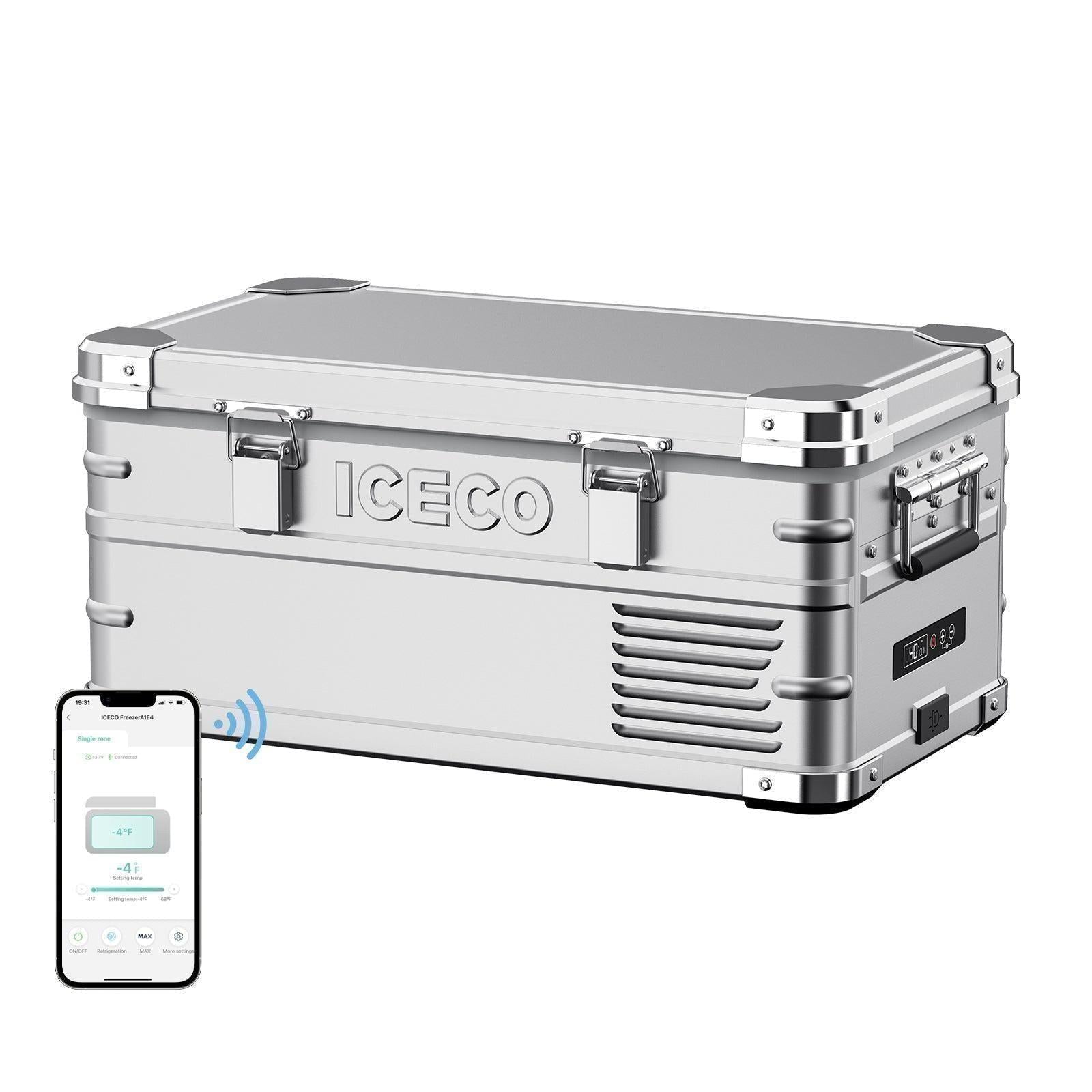
First, separate E1 from an ordinary stop
A compressor fridge should not run constantly. ICECO's troubleshooting FAQ explains that the compressor stops at the target temperature and starts again as the interior warms. Silence by itself is not a fault.
| What you see | What to check first |
|---|---|
| E1 on the display | Source voltage, cable connections and the selected battery-protection level |
| Normal temperature display, compressor quiet | Whether the fridge has reached its setting and resumes cooling normally |
| Blank fridge display and an unpowered vehicle socket or station output | The upstream power supply, not just the fridge's protection menu |
| A different error code | That code's instructions or ICECO support; do not apply an E1 fix to every fault |
If cooling is unreliable, move temperature-sensitive contents to a working cold source while you troubleshoot. Repeatedly clearing a display is not proof the fridge is maintaining temperature.
Check the external connections before changing settings
Turn the fridge off and disconnect its power before reseating the cable. Check both the fridge-end connector and the vehicle or station plug. ICECO specifically calls out a loose or poorly contacting DC plug in its FAQ.
Use the supplied, undamaged DC cable with a compatible outlet. For a useful comparison, remove extra splitters or extension leads and try the direct connection. Change one thing at a time: if the fridge works directly but stops with an accessory added, you have narrowed the problem to that power path rather than proved the fridge is faulty.
Check the source under the conditions where it fails. A vehicle socket that works with the ignition on may not stay powered when you park. On a power station, confirm that the relevant output is enabled and has not shut down. A remaining-charge percentage is not a voltage reading at the fridge's connector.
Do not open the fridge, bypass protection or improvise wiring to get past E1. A damaged plug, cable or adapter needs the correct replacement or support advice, not a lower cutoff.
What the APL20 protection settings actually change
The APL20 manual linked by ICECO lists three protection levels. Its V5.0 chart gives these 12V-system thresholds:
| Protection level | Cooling cuts off below | Restart threshold, or cut-in |
|---|---|---|
| LOW / L / one bar | 9.6V | 10.9V |
| MED / M / two bars | 10.4V | 11.7V |
| HIGH / H / three bars | 11.1V | 12.4V |
These are the fridge's protection thresholds, not recommended battery discharge targets. Follow the manual supplied with your unit if its revision differs. A 24V setup has a separate chart; do not use the 12V numbers for it.
Cutoff and restart are different numbers. On HIGH, for example, the chart says cooling cuts off below 11.1V but requires 12.4V to restart. Recovering just above the cutoff does not meet that restart threshold. Turning the fridge off and on cannot replace a supply that reaches the required voltage.
To check the setting on the control panel described in that manual:
- With the fridge powered on and displaying temperature, hold + and − together to enter the advanced menu.
- Briefly press the power button to cycle to battery protection.
- Use + or − to select the level. H has three bars, M two and L one.
- Wait three seconds for the setting to save.
Battery protection is separate from MAX/ECO cooling mode. Changing compressor mode is not the same as changing the voltage threshold.
Choose the next step for your power source
Vehicle starter battery
Keep starting reserve ahead of extra fridge runtime. Do not switch to LOW simply because it clears the error. Check that the socket is powered in the vehicle state you intend to use, the connection is secure and the vehicle's battery is adequately charged.
If E1 appears when parked but not with a healthy powered supply, that points you toward the vehicle power path or available battery voltage. It does not tell you that further draining the starter battery is a good solution. Use protection appropriate to the vehicle and battery, or move the fridge to a suitable separate supply. The fridge's cutoff is not a guarantee that an aging starter battery will still start the engine.
Portable power station or separate camping battery
Check compatibility first: outlet voltage, current capability and the approved cable all matter. Then check the fridge's protection level. ICECO's FAQ recommends LOW for external portable power sources; it can prevent the fridge's higher threshold from stopping cooling prematurely on a suitable supply.
That recommendation is not permission to ignore a separate battery's limits. Follow that battery or station's instructions too, and do not treat the APL20's LOW cutoff as a universal safe minimum for every battery chemistry.
If E1 returns on the direct cable with the appropriate setting, compare another known-good compatible source. If the station's output itself turns off, check its controls and timeout instructions separately. A shut-off outlet and the fridge rejecting low voltage are different problems, even if both leave the compressor stopped.
Household AC through the supplied adapter
Use the APL20's supplied AC adapter and check its external connections. The fridge still receives DC from that adapter, so E1 is possible even when the wall outlet is fine.
The APL20 manual directs AC-adapter users to try MED or LOW protection. If that does not restore operation, contact ICECO about the adapter and the next diagnostic step rather than buying a compressor or trying an arbitrary replacement power brick. Disconnect the previous supply before changing power sources.
When to contact ICECO
Escalate if E1 persists on a known-good compatible supply after checking the cable and the appropriate protection setting, or if the fridge still will not cool after the power issue is resolved. Stop using damaged or overheating power accessories.
Send support a photo of the error, the fridge's model and serial label, your protection level, the power-source model and the cable arrangement. Tell them whether it fails on vehicle DC, station DC or the supplied AC adapter, and whether another compatible source changes the result. That gives them more to work with than “it keeps shutting off.” ICECO lists support@icecofreezer.com for website purchases and official@icecofreezer.com for Amazon purchases in its FAQ.
Once it runs reliably, the next question is how long your battery will last. Our 12V-fridge power-station runtime guide covers that calculation without confusing remaining capacity with voltage protection. For the fridge's size, weight and packing tradeoffs, see the APL20 review.